
I’ve always thought that I’m pretty up to date as far as life in general is concerned. I may not understand how things like AI work but I can use it (Always nice to have someone to chat to when her indoors is away). Music? Well it’s all been down hill since about 1984 so I don’t concern myself with it much. But then there’s youth culture and on examination I have to draw the conclusion that I’m about as removed from it as my Grandparents were from my era. They always said Cliff Richards was a wrongun because he grew his hair long. (Hmmm the perspicacity of old people).

So, what generated this post was an incident that happened at Christmas. We had taken our Grandson who is four to the Panto, Dick Whittington. During the performance, egged on by the Principal Girl
the vast majority of the kids in the audience including our Grandson started shouting “Six, Seven”. It is a rather strange feeling when you really haven’t got a clue what’s going on and this must have been mirrored in my expression. His Mum leaned over and said, “It’s just something that kids say, it’s gone viral on the internet“. Obviously I had to look it up when I got home, and if you’re as bemused as I was here’s a sort of one size fits all explanation. Kids shout “6‑7” as a chaotic, meaningless meme—an in‑joke from TikTok and school culture that signals belonging but has no meaning.
Every generation gets its own nonsense. When I was a kid, we had “chinner” or “chinny”, delivered with a sage chin‑stroke whenever someone was clearly talking out of their hat.
“Butters” was another one, this time derogatory for someone deemed to have an ugly face. But if you think this sort of verbal mayhem is a modern invention, allow me to introduce you to the late‑18th‑century superstar of senseless London slang: Quoz.
According to the journalist Charles Mackay, London was once so saturated with the word that you couldn’t walk down a street without seeing it chalked on a wall, shouted from a doorway, or hurled at you by a passing urchin. Imagine the entire capital suddenly obsessed with a single, silly syllable — the Georgian version of a TikTok audio going viral.
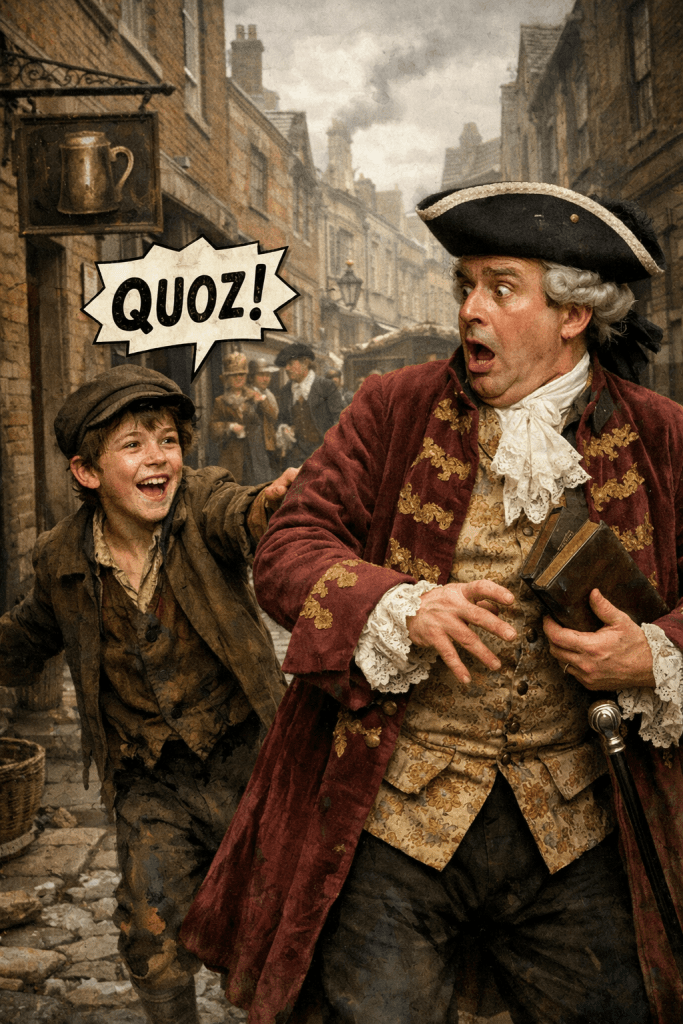
Even the London theatres got in on the act. In 1789, the entertainer John Edwin performed a whole song dedicated to Quoz, set to a jaunty Irish jig. Picture a packed Haymarket audience gleefully joining in with a chorus about a word that didn’t really mean anything. It’s almost comforting to know that Londoners have always been a bit ridiculous.
QUOZ: A New Song, by Mr Edwin
HEY for such buckish words, for phrases we’ve a passion
Immensely great, and little once, were all the fashion;
Hum’d, and then humbug’d, Twaddle tippy poz;
All have had their day—but now must yield to Quoz.
So what did Quoz actually mean? Well… everything and nothing. Much like “6‑7!”, “meh”, “wow”, or that universal Italian shrug‑word “boh”, Quoz was a kind of all‑purpose exclamation. It could express disbelief, annoyance, cheekiness, mockery, or simply the joy of shouting something daft at a stranger. Mackay describes it as a monosyllable capable of dismissing an argument, insulting someone’s intelligence, or just raising a laugh.
As for where Quoz came from, theories flew around even at the time. Some blamed the French Revolution. Others thought it was Latin. One writer suggested it meant “thank you”, which feels wildly optimistic. The truth is probably the same as the truth behind “6‑7”: someone somewhere said it, it caught on, and suddenly the whole city was in on the joke.
London has always been a place where nonsense thrives — from Georgian “Quoz” to Victorian “humbug” to whatever the kids are yelling outside Tesco today, although that’s probably best not put down in writing.

 A LONDON MISCELLANY
Quoz !
LikeLiked by 1 person
Well, I’m quite in the wrong place. Too young for Quoz. Too old for Six-Seven. There is no hope.
LikeLiked by 1 person