
Probably every family in the UK that celebrates Christmas will have one such story of disaster, calamity or injury that is trotted out over the festive table to the mirth and hilarity of all those seated around it. Like the time Dad cut his finger off carving the turkey or how mum fell off a large ladder trying to place the star on top of the Christmas tree, priceless! I suspect the majority of these have, over the years become somewhat embellished. The severed finger no more than a cut and the ladder being a small step stool, however we only have to look back at the instigators of our modern Christmas, the Victorians to find records of truly terrible festive incidents.
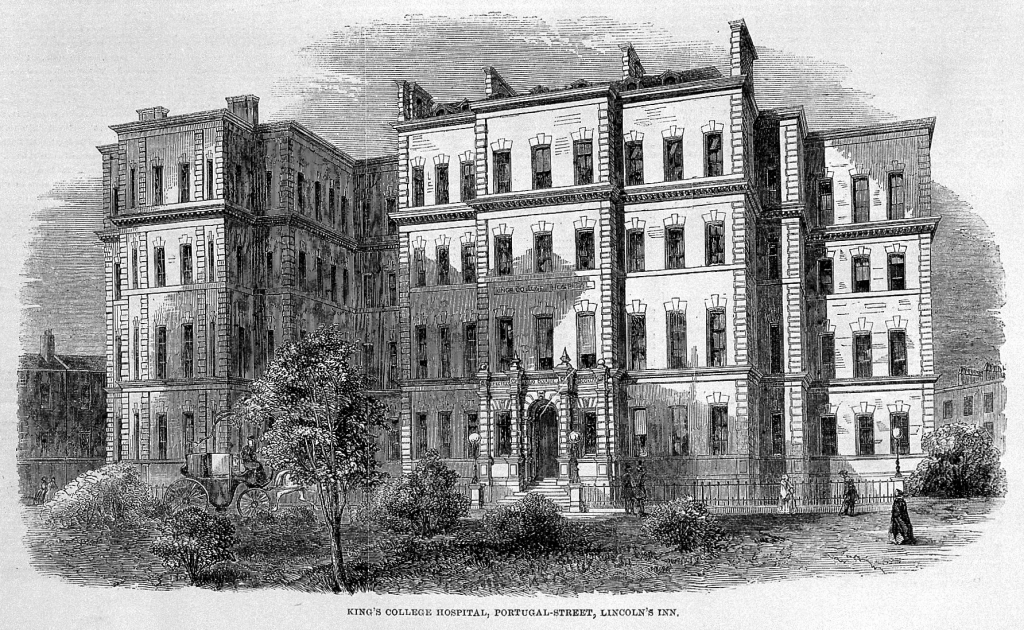
The tree is always a good starting point. Today it is well known, or it should be that holly berries are poisonous. In 1858 this fact was little known, as shown in the case of 11-year-old boy from a middle class family living in Holborn, who was admitted to King’s College Hospital which then was just up from today’s Aldwych in serious distress

From statements taken from his friends, the boy during Christmas Eve 1858 amused himself by eating a large number of the small red berries adorning the tree. Some time later he experienced convulsions and severe vomiting, which continued overnight and into Christmas Day. It’s not clear what action his family took, but I could find no mention of summoning a doctor. Towards dawn his breathing appeared to have stopped and as a last resource a little wine was poured into his mouth which seems to have some effect on the sick child. Boyed by this the parents proceeded to pour the contents of a bottle and a half of wine into their son before finally deciding to take him to hospital!
The festive meal itself could be a source of much peril. Take the case of Mr Marshal Harrison, who on Christmas Day 1878 sat around the table with family and friends in his Bayswater house to enjoy the traditional roast turkey and all the trimmings. I’m not sure if the Boxing Day sales were a thing back then, but had Mr Harrison had plans to go bargain hunting he would have been unable to, due to the fact that by then he was dead. Of the eight people gathered for lunch that day seven of them became severely ill during the evening. The eighth guest being for the times a rare individual, a vegetarian, manage to swerve all the symptoms. The serving maid also succumbed, but strangely not the cook, a Mrs Winters. All but Mr Harrison survived the ordeal.

With Victorian zeal all the constituent parts of the meal that remained were bagged up and sent to the London Hospital in Whitechapel where they were examined by a Mr Rogers, who quicky reported that he had seen such a case before regarding a goose, which lead him to conclude that the turkey had been “Poisonous in it’s nature“. This has to be taken in the knowledge that pathogens and their effect were not widely known and Food poisoning due to undercooking was not a warning that was commonplace. My take on the story is that the cook, Mrs Winter saved a few quid on a turkey that was well past it’s best, undercooked it and knowing it’s provenance gave it a miss.

The traditional plum pudding seems to have been attributed to several fatalities over the years. A Mrs Chambers of Jermyn Street appears to have choaked to death on a trinket secreted in her portion of pudding in 1892, but the pudding itself gets a very bad press in it’s early days. It seems to have come into the nations consciousness as a “Thing” around 1845 when a recipe for it was produced in a cookbook published by Eliza Acton. The following year it seems that parts of the medical profession had taken against it, with a piece in the Medical Advisor stating “This is one of the relics of barbarous cookery — a compilation of grossness, gastronomically unscientific, and pre-eminently unwholesome. Sugar, dough and fat are its basis, and in such proportion, that its lighter ingredients have not power to redeem its crudity.” It then crops up occasionally in cases where a diagnosis is not forthcoming. The Surgeon Sir Everard Home relates the case of a child, who, being left by its nurse beside a plum pudding, was found dead a few minutes afterwards, and in whose body no appearance of note could be discovered, except enormous distension of the stomach from consuming the Plum Duff.

Over indulging at Christmas in general was also a fatality waiting to happen. Mr Tobias Middleton a well to do merchant and corpulent gentleman residing in the area around Bun Hill Fields died suddenly fifteen minutes after dinner in 1830. It appears that Mr & Mrs Middleton did not lead a harmonious marriage and suspicion arose that she had poisoned him. His wife said that he fell asleep immediately after dinner on Christmas Eve; but had not slept for long when he suddenly awoke in great agitation and exclaimed he was dying, and actually expired before his physician, who was instantly sent for, could arrive.


An autopsy was performed by a Dr Wildberg who found the stomach so enormously distended with Bread, ham, pickles, cabbage-soup, several fowl, chops, and the demonic Plum Pudding that when the stomach was laid open it’s contents cascaded onto the floor. Copious amounts of white powder was found on the lining of the stomach, and it was at first suspected to be arsenic, but it proved on analysis to be merely magnesia, which the gentleman had been in the habit of taking frequently and in large quantities and there was some doubt as to which of the two actually did for him.
The final word goes to that stalwart of Christmas catastrophes, alcohol. Countless numbers of Uncle Norman’s and Auntie Cath’s have disgraced themselves down the centuries by having one too many and then behaving as we say now inappropriately, while the link between drinking and driving at Christmas and fatality is well known. However, back in previous Christmas’ if the alcohol itself didn’t get you then some of it’s ingredients may well have done.

The Victorian age is infamous with the practice of food adulteration and so it was with drink as well. During the Christmas period of 1846 a number of suspicious deaths were reported around the area of Southwark. Many of these were working class men and the authorities didn’t really spend too much time on investigating the causes, that is until Boxing Day when a businessman Christopher Stevenson was admitted to Guys Hospital where he later died. His family pressed for an autopsy and it was later found that he had died of an overdose of Cannabis and Opium. The family shocked at the findings vehemently denied to an excited press any link with drug taking and his demise, and in an age where the two substances were widely used in over the counter medicines, no such drafts had been taken by Stevenson or even found in his home.
Due to the stature of the family in the area the police were forced to examine the case in more detail and while doing so someone decided to look at the other unexplained deaths of the past few days. In all cases they came to the same conclusion an overdose of narcotics. The dead men had all frequented a small tavern, The Rose, near to Bankside, but they found no connection to it with Stevenson. It appears that the local brewer, James Faustich, had underestimated the upturn in demand for his ales over the Christmas period and having already sold all of his finished ales was left with several batches only partially fermented. These were much weaker in strength and were sure to be challenged in the local hostelry’s as they would fail to inebriate the clientele, so he decided to pep them up a bit with a distillation of the two drugs. Unfortunately he miscalculated the dosage, which proved fatal for anyone drinking more than five or six tankards at any one sitting, a modest amount for a working man at the time. But what of Christopher Stevenson? Well it turns out he was a self made man and to pay homage to his humble beginnings would treat himself to a barrel of ale over Christmas, a drink reserved only for himself and the cumulative effect of consuming the barrel over a number of days did for him.
In 1896 John Playton a labourer from Clerkenwell was out carousing with his friends on Christmas Eve and partook of a very large quantity of ale in neighbouring Smithfield. On returning to his room on the third floor of the building he opened the window to allow some air to flow around his befuddled head and promptly fell out, landing on the cobbles below. In this case it appears adulteration saved him as it was later found that the unscrupulous brewer had laced the batch of ale with Coculus indicus. This is the fruit of a climbing plant found in India and parts of south-east Asia. It is a narcotic which was sometimes used to adulterate beers to shorten their fermentation period, a practice which made it far more potent. It appears that Playton was more off his face on the narcotic than the beer and had slipped into a coma before falling. Despite several broken ribs and a cracked skull he survived the fall and his doctors put this down to the relaxed state of his body.
Well I’ll leave the last word to what is rapidly becoming a favourite publication, The Medical Advisor. It’s voracity and randomness of both thought, comment and explanation is something I wish I could read more of. They do seem to have a downer of the old Christmas pud and apparently two other things that are to be shunned, although I fail to see any medical reasons why in the other two.
“Yet we wonders why they suffers from indigestion! Leave off plum-pudding. The French, who know better than we do the science of cookery, laugh at us for still patronizing it. We know what it is to oppose a popular prejudice; we did so with cravats and marriage-beds, but we cannot blink truth.“
Cravats, Marriage Beds and Christmas pudding, the Devils Triumvirate!

 A LONDON MISCELLANY
My goodness. I’ll avoid any temptation to travel back to a Victorian Christmas dinner this year I think. But a happy Christmas to you nevertheless!
LikeLiked by 1 person
Say NO to the plum pudding! Cravats (and their successor, the necktie) are, in truth, the Devil’s own devices. Not sure what’s up with the marriage-bed. ~Ed.
LikeLiked by 1 person