
In many ways it’s an unpromising but not unpleasing building at 101 Union Street, Southwark. Unpromising in the respect of that it’s not the original that I was searching for. On maps of the 1840s it shows a pub on the corner, the Three Jolly Gardeners and the building I’m looking for next to it. I had in my mind a small shop fronted abode faced with London stock with a small, weathered wooden sign hanging over the entrance denoting Blanchard.
So, what is it that I’m searching for? These premises were the home and workplace of a man that to me should be enshrined in some way, there should be a monument, a temple even to his perspicacity. This man took four simple things and assembled them to create a synergy unsurpassed. Yes, I’m speaking of the man who first sold Pie, Mash, Eels and Liquor to the general public.
I should at this point say that in the following lines anything I say about what a constitutes proper Pie, mash, eel or liquor should be pre faced with the line “In my opinion“. To some the subject has a divine status and is to be taken seriously, cogent and forthright arguments are made concerning the slightest variation in recipe or serving. Also the term “scoff” to denote a plate of the finest is a term I heard a lot growing up in north west London, but may not be in wide usage today or in other parts of the city.
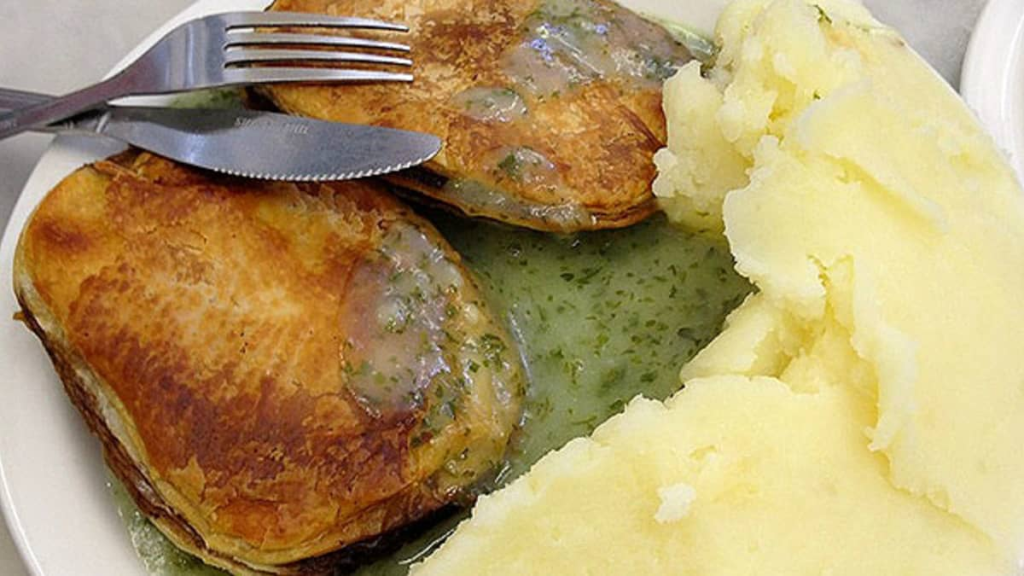
Henry Blanchard’s at 101 Union Street in Southwark opened in 1844 and was described as an “Eel Pie House”. He was not the first to sell pies in the metropolis, but he was the first to combine all the constituent parts we know today. A historic pie quest can take you back as far as Roman Londinium to find sellers of tortae. Apparently your Roman Londoner loved ’em and they were usually to be found for sale close to the public bath house.
Well to do Medieval Londoners would no doubt enjoy a Coffyn. An oblong affair with a lid filled with beef, lamb, wild duck, magpie, pigeon, and spiced with pepper, currants or dates, although possibly not all at the same time.

The less well off citizens would probably have to content themselves with just the pastry left over from their betters table, but on high days they might be lucky enough to feast on an un lidded offering which contained chopped intestines from a deer, known as the umble, which is where the expression “to eat humble pie” comes from.
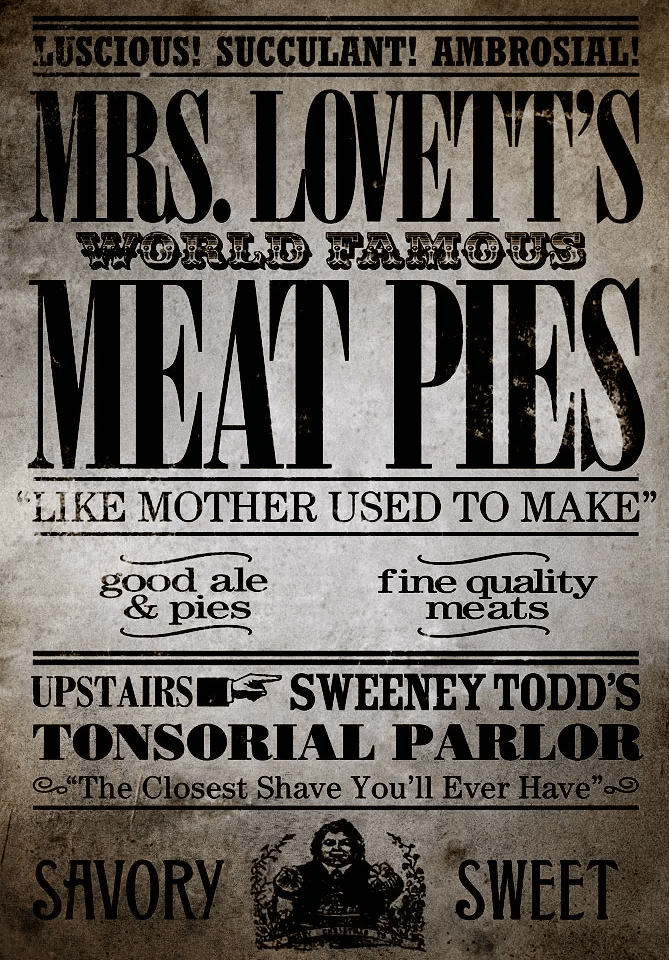
Around fifty years before Henry Blanchard’s brainwave you’re average Londoner wanting to grab something to eat on the go would head straight for the nearest pie shop where Mutton seems to have been the standard, although the pie shop of Mrs Lovett did manage to ring the changes with a ready supply of meat from the demon barber of Fleet Steet, Sweeney Todd. The classic “pie n mash” pie should consist of a suet pastry bottom with a short crust or flaky pastry lid and some savoury meat filling who’s origins are difficult to ascertain.
So pies have been around since the beginning’s of the City, but what of that stalwart mash? Sir Walter Raleigh is credited with the potato’s introduction into England in the 1580s but some sources have it that he only brought the first ones back as a novelty item to impress Queen Elizabeth.

It is believed that a compatriot aboard Raleigh’s ship, the astronomer Thomas Harriot saw their potential and began to grow them on his return from the Americas. We have an 18th century cookery writer to thank for that staple of comfort eating, mashed potatoes. Apparently the first standardised recipe ever published was by Hannah Glasse in 1747 showing the correct proportions of potato, milk, butter and seasoning. Although the classic “pie n mash” mash has none of the last three ingredients. By this time the potato was a working class staple and as cheap as…….chips!

So on to the constituent part that makes a lot of people squirm, the eels. Eels were historically a cheap, nutritious and readily available food source for the people of London. European eels were once so common in the Thames that nets were set as far upriver as Putney, and eels became a staple for London’s poor. Again there are mentions of the inhabitants of Londinium feasting on such an abundant and close food source. It’s possible that Henry Blanchard sold eel pies as they were a much cheaper ingredient than meat, but I’d like to allay a misconception. Today’s proper “pie n mash” pies do not contain eels, end of.
They do not or should not contain any offal. I was once privy to a conversation with one of our colonial cousins who stated that “as sure as hell I won’t be eating any of those Godam kidney pies that you Brits enjoy” His host assured him that no such dish existed and perhaps he was mistaking the inclusion of some diced kidneys to enhance a beef pie, but he wasn’t having any of it (literally). When asked what he liked to eat he responded “Good wholesome American food“, prompted he went on to list his favourites, “Pizza, Hamburgers and Tacos“, “and how about a triple portion of irony”, I thought to myself.

The traditional serving of eel’s with your scoff can take two forms. The jellied or the hot, both should be granted protected food status. The jellied are served cold after boiling and the gelatinous nature of the eel sets the liquid into a jelly. The hot are the jellied served in a bowl swamped in an ocean of liquid ambrosia known as liquor.

Liquor is also served with the main dish. It takes the form nowadays of a thinnish white sauce probably made from water and flour, which contains chopped parsley. Grizzled traditionalist will tell you it was better when it was made from the liquid used to boil the eels in, but I’m not of a vintage that can remember that and I doubt if the practice is used today. The early liquor’s contained chervil instead of parsley, apparently because it grew in a lot of London’s streets and was readily available. I do hope they washed it before use.
Today’s Liquor should not contain anything else but water, a thickening agent, parsley and seasoning any attempts to introduce white wine, chicken stock, or even to describe it as a Jus should attract a custodial sentence. The use of gravy is prohibited, but some pie shops do pander to this obsession of our friends in the north. The Liquor should always be beneath the pie never poured on top of them. Your pie or in my case pies should float amidst a pool of liquor held back by a craggy dam of mash.

Two other important things to note. The first is the accompaniments. salt is optional, white pepper and chili vinegar are not. How the latter and rather exotic condiment came about is open to conjecture. I favour the thought that it came from the shipment of chili’s from the Americas in the 18th and 19th centuries. Many were shipped as dried chili’s but this incurred a delay in shipment after picking due to the drying process. It was far quicker to place the chilli’s in a pickling solution and ship them straight away. These ended up in London’s copious docks and the dockers natural curiosity being what it was tasted and developed a liking for the spicy condiment. Dockers being East End folk who ate pie n mash for every meal adopted it as their own and that’s why it’s served today. * The second important thing is the utensils used to convey your scoff to your cake ‘ole. A spoon and fork are de rigueur and non negotiable.

So what’s prompted me to go on this rant or should I say Pieotribe against malpractice in the pie shops of London. It’s the sad news that another traditional Pie n Mash emporium is due for closure. Harrington’s in Tooting, South London has been been purveying pies in the time honoured way for over 116 years under the same family. I shall embark on as many visits as possible before that mournful day.
It’s a sad reflection of the demise of the traditional pie shop. At the turn of the last century it was estimated that there were around sixty such shops in central London. Now there are less than twenty.

Some put it down to gentrification of working class areas, which in some way connects with my view that too many people have buggered around with something that didn’t need changing in the first place. People not schooled in the tradition see these fanciful concoctions containing chorizo, duck and even ostrich along with the dreaded Jus and highly inflated prices charged by Mockney outlets and feel they been ripped off, and the truth is they have.
Happily there are many like minded guardians of the art form and some of them get together to seek out new emporia wherever they can be found while letting you vicariously enjoy those traditional outlets that you may not be able to visit. Their sterling work can be found HERE
So my heartfelt plea today is support your local Pie n Mash shop, because it’ll be gone if you don’t and then you’ll never know that feeling of well being, calm and serenity as you shovel the scoff in as fast as you can go.
* This may not be factual

 A LONDON MISCELLANY
I would willingly try a dish of pie and mash but I wouldn’t know where to go to get one. Though I see from your link that there’s a place in Deptford, which isn’t too far from my son. And making my own is out of the question as I definitely don’t know where to buy eels. Growing up in London, I used ‘scoff’ in the way you describe, but come to think, I haven’t said it in years. Or heard it come to that. An interesting post as ever.
LikeLiked by 1 person
Thank you, it’s a subject close to my heart and stomach. Well, when in Deptford do as Deptfordians do and get a plate of scoff (eels optional)!
LikeLiked by 1 person