
I currently have a little side project going on. I’m writing a tour which uses a train as transport rather than walking. I’m writing it along with my Dad, who”s something of a railway historian.
I thought it might be nice to write a tour where the listener can sit back in the comfort of their own seat, watch the scenery go past and be given some interesting facts at the same time. The trouble is I know next to nothing about the chosen lines history, hence my Dad’s involvement. He supplies the technical knowledge and I look after the social history aspect. This leads me on to the main part of this post.

Today’s modern London overground line from Richmond to Stratford takes in some of the Victorian North London Railway line and during my research I came across a story that had Victorian’s in a state of fear and apprehension. It was later dubbed the First Railway Murder and took place on the 9th July 1864.

Thomas Briggs, a 69-year-old City of London banker, was beaten and robbed while he travelled on the 9:50 pm North London Railway train from Fenchurch Street to Chalk Farm. His still breathing body was then flung from the moving train just before Hackney station. On the arrival at Hackney, a gentleman called the attention of Benjamin Ames, the guard, to the state of a compartment of a first-class carriage, No. 69. He had opened the door at Hackney with the intention of getting in, and had placed his hand on one of the cushions, which he found to be covered with blood. Ames on looking in found not only the cushions, but the floor, sides, and windows were smeared with blood, in some places there was quite a pool.
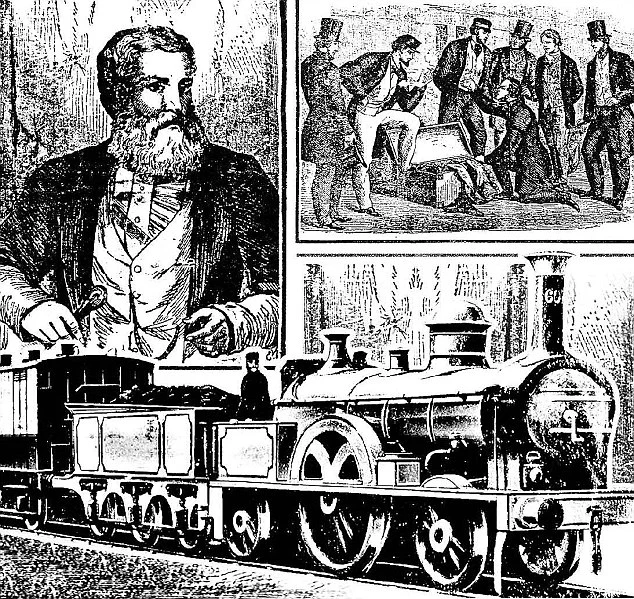
Alfred Ekin the driver of an engine on the opposite tracks saw what he thought was an obstruction on the line and stopped to investigate. He found Thomas Briggs unconscious and bleeding from a large wound to the side of his skull. The Station Master at Hackney was alerted and a party of station workers was despatched to collected the gravely injured banker from the line. Brigg’s body was carried a short distance to the Mitford Castle pub and laid on a large table in a back room parlour, while medical assistance was sought.

Several doctors attended the gravely injured banker and all concurred that he had suffered at least six blows to the head. It’s unclear from accounts what they decided to do. Some reports say Brigg’s was left on the table, while others say he was conveyed to his home address, but there’s no mention of sending him to hospital. Whatever the outcome was, Mr Brigg’s died of his injuries the following day.
The police were called to investigate the blood stained carriage and a hat, a walking stick and a small bag were taken away as evidence. The furore in the newspapers once the murder had been announced was unprecedented. Not only was public opinion pressurising the police for a speedy outcome, but also the railway companies as a whole. They realised that this violent act could destroy public confidence in using the train network and put pressure on the home Secretary, who passed the grief down to the Commissioner of the Metropolitan Police, who put his best man on the case, the young but brilliant detective Richard Tanner.

A cab driver came forward with suspicions about a German man known as Franz Müller. He told the police that the 24-year-old tailor had come to his house to sell him a gold chain in a box. The box had been sold by a jeweller in Cheapside, who identified Müller from a photograph and told investigators that the German had visited his shop on 11 July to exchange a gold chain. This was later identified as belonging to Briggs.
Tanner went over the findings of the original investigation of the carriage. It appears that a cloth cap had also been found under the seat but the police team had dismissed the item as worthless. Tanner found inside the cap the makers name and on following this lead he was able to deduce that the owner was Franz Müller. With these two pieces of evidence, a warrant for Müller’s arrest was issued

However, by the time an arrest warrant was issued, Müller had boarded a sailing ship and sailed for New York. Tanner in pursuit boarded a steamer, the City of Manchester. The faster ship arrived in New York two weeks before the German and Muller was subsequently arrested as he stepped off the ship. Among his possessions were Briggs’ gold watch and hat.
Much of the evidence against Müller was circumstantial, but the prosecution made a strong case. Müller maintained his innocence throughout his three-day trial at the Old Bailey, but he was found guilty and sentenced to death. King Wilhelm of Prussia, subsequently the Kaiser of Germany, failed to get the British Government to postpone Müller’s execution.
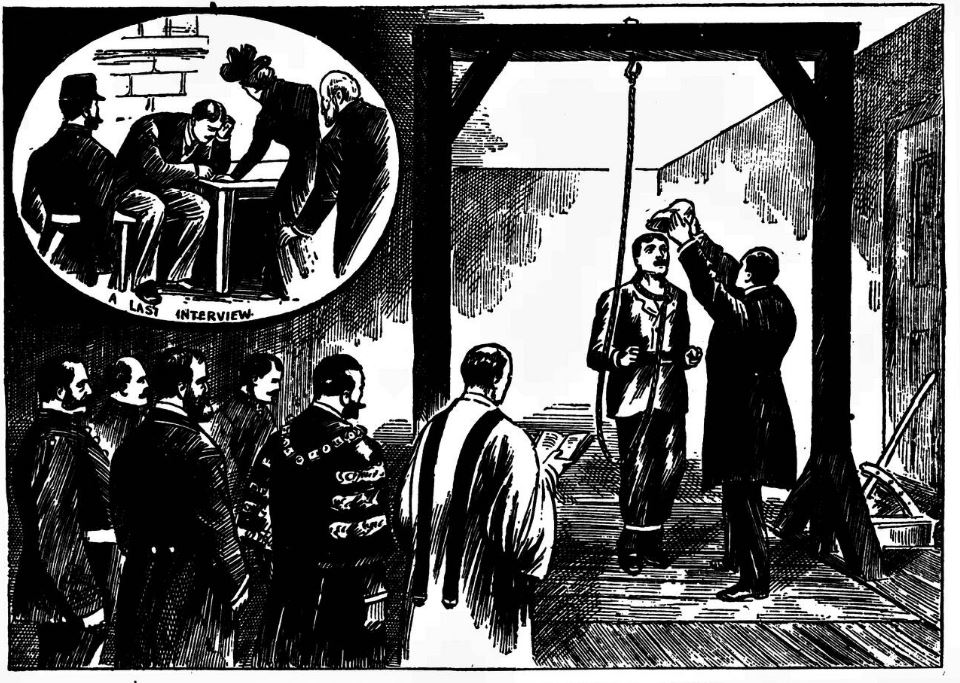
Muller’s public execution took place outside Newgate Prison in London on 14 November amid scenes of drunkenness and disorderly conduct by many of the 50,000 spectators, with a strong undertone of anti German feeling.

Despite consistently claiming innocence at his trial and while awaiting sentence, Müller reportedly confessed to the crime immediately before being hanged. Dr Louis Cappel, the German-speaking pastor appointed to attend the prisoner, claimed afterwards that Müller’s last words in German were “Ich habe es getan“, “I did it“.
Briggs had been murdered in a closed compartment that had no corridor, so after the train started there was no way to leave until the next station. Public reaction in the case resulted in the establishment of the communication cord on trains that allowed passengers to contact members of the railway crew, as required by the Regulation of Railways Act 1868.
It also led to the creation of railway carriages with side corridors, which allowed passengers to move from their compartments while the train was in motion. Old compartment stock was modified by some companies to include circular peep-holes in the partitions so you could see into the next compartment and these became known as —”Müller’s Lights“

 A LONDON MISCELLANY
Gosh. My limited exposure to the London Rush Hour makes me glad I’m not a regular commuter. But the fear of being murdered hadn’t been at the top of my list of objections. What a gruesome tale. Though happily, forensics seem to have moved on a bit since those days.
LikeLiked by 2 people
Yes I think the police got lucky with a very incompetent murderer and a trial that was skewed in their favour. Did he actually do it? 50/50 call when you read all the details.
LikeLiked by 2 people
What a story!
Thank you for sharing!
And good luck for yourproject
LikeLiked by 1 person
Thank you
LikeLiked by 1 person