
I was doing a bit of housekeeping with my audio tours the other day and came across a tour that I must admit I’d forgotten all about. Everything about the process of compiling it I remembered was easy. The research went well and the writing just flowed from the pen. This was going to be good I thought, from concept to testing within a fortnight…..Wrong!
I had been vaguely aware of the plans to develop the “Justice Quarter” just off Fleet Street, but that’s as far as it went, I never bothered to look at the location or the scale of work that was going to be needed. So, as I wandered up from Blackfriars station I became aware of three massive cranes, wonder what their doing I thought, I was about to find out.
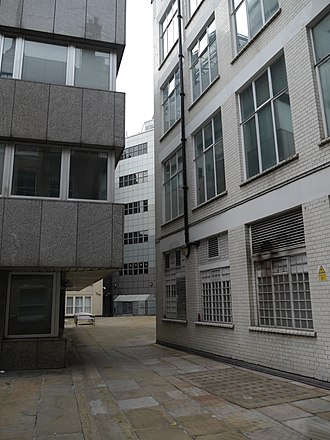
Due to the construction work a favourite part of the tour cannot for the foreseeable future be told. This took place over three years ago and work is still ongoing and so the tour has languished in my unpublished folder for all of that time. Estimates are that the building work will be finished in 2027 but there is no guarantee that the courts and alleys in which the story is set will still be there. It is a great story, so I thought I’d share it here.
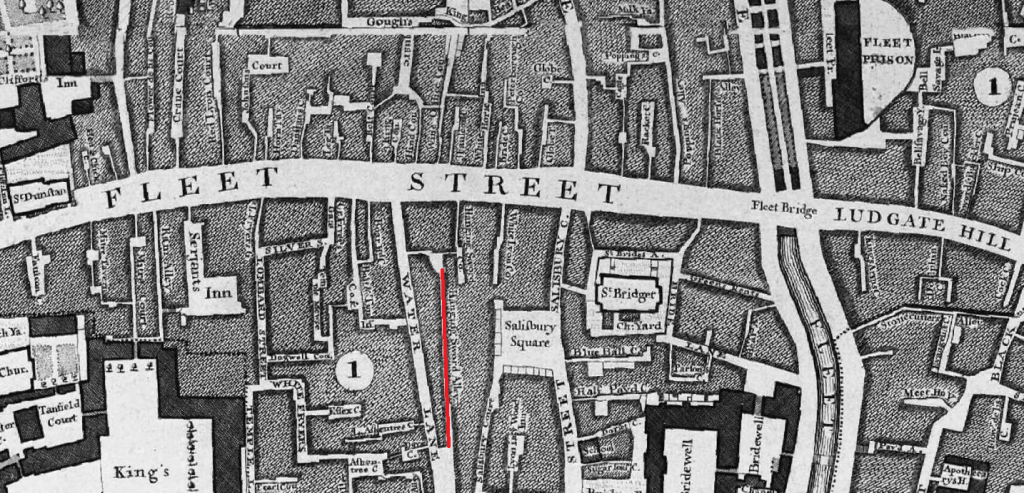
The story relates to Hanging Sword Alley which runs off of Fleet Street. Some stories will tell you that it is so named because Cavalier soldiers were obliged to hang their swords up in the alley before entering a tavern that was located there. It’s a nice explanation with a lovely motif, but I don’t believe it to be true. What of all the other alleys with taverns frequented in the 1600s by rowdy supporters of Charles I, why aren’t they called the same name if this was a common practice? No, the etymology is older and slightly more mundane but the story that goes with it is a much more lurid one.

Back in the 1600s, the alley had many entrances and exits from Fleet Street, Whitefriars Street and the area directly behind Bridewell Prison. The alley took its name from a signboard with a sword attached to it to denote the premises of a Fencing School which once hung within the alley. It was the place of business in the early 1600s of John Turner the greatest exponent of the art of fencing in England. It’s also the site of his brutal murder by two armed assailants.
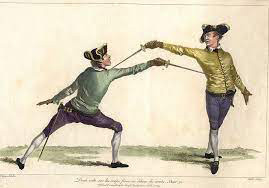
Around 1605, Turner took up an invitation to arrange a fencing display for Lord Norris in Oxford. This was attended by many young men of society to watch and participate with the professional swordsman.

It appears that in a bout with a young Scottish Nobleman, Lord Sanquhar, Turner was verbally abused by the Lord, perhaps in jest for the amusement of his peers. In the ensuing contest, Turner pierces the Lord’s eye with his rapier, causing him to be blinded. Accounts of the incident do say that Turner was mightily sorry for the accident and pled his innocence and lack of malice in what had happened. It appears that the young Lord also took it to be a blameless accident, however over the next few months his attitude changed and a grudge against Turner was formed.
Several years went by and then on a visit to the court of Henry IV of France, the King took an interest in the young Lord with the green taffeta eye patch and enquired as to how the injury had occurred. Sanquhar not wanting to seem foolish in front of the King replied “It was done, your majesty, with a sword.” The king replied, thoughtlessly, “Doth the man who did this live?” and no more was said. This remark, however, awoke the viper of revenge in the young man’s soul. He brooded over those words, and never ceased to dwell on the hope of some revenge on his old opponent. For two years he remained in France, his resentment growing by the day.
On his return to England, he tried on two separate occasions to waylay Turner with the aim of getting retribution but failed on both attempts. Finally, in desperation, he hired two men, Carlisle and Irving to murder Turner.
On the 11th of May, 1612, about seven o’clock in the evening, the two murderers came to the Crown Tavern, which Turner usually frequented after lessons at his nearby fencing school. Turner was sitting on a bench by the door drinking with one of his friends. On seeing the men approach he saluted them and asked them to take a drink with him. Carlisle turned to cock the pistol he had prepared, then wheeled round, and drawing the pistol from under his cloak, discharged it at close range into the fencing master and shot him near the left breast. Turner had only time to cry, “Lord have mercy upon me—I am killed,” and fell from the ale-bench, dead.

Carlisle and Irving at once fled pursued by the taverns customers, Carlisle to the City, Irving towards the river but the latter mistaking a dead-end court where wood was sold for the turning into an alley was instantly run down and taken. When questioned by a Sherriff, Irving implicated Lord Sanquhar in the plot and gave details about Carlisle, who was caught some weeks later in Scotland.
Sanquhar was arrested and immediately threw himself at the mercy of King James I to intervene in the case. However, no intervention from the monarch was forthcoming. It was necessary for James, who was also James VI of Scotland to show that he would not show favour to a Scottish criminal due to the disquiet in some parts of England about him becoming monarch.
Sanquhar was tried by his peers at Westminster Hall and found guilty. On the 29th of June Lord Sanquhar was hung before Westminster Hall. On the ladder, he confessed to a large and vociferous crowd the enormity of his sins but said that till his trial, blinded by hate and the Devil he could not see he had done anything unfitting a man of his rank and quality. Carlisle and Irving were hung some days later on gibbets placed in nearby Fleet Street.

 A LONDON MISCELLANY
Bloodthirsty but fascinating. I hope you get your tour back one day soon!
LikeLiked by 1 person
Interesting bloodthirsty tale! I hope the tour become possible at some stage
LikeLiked by 1 person