
Looking back at my last couple of posts they’ve been a bit negative, so I thought I’d relay this short but heart warming Christmas tale of a character well known to Londoners who frequented the area of Gracechurch Street.
The street was once described by the historian John Strype as one of the fairest streets within the City. The name Gracechurch is though to be a corruption of Grass Church, as there was thought to have been a market in the area for selling hay and straw possibly dating back to the Roman occupation as the area is close to the location of the Roman Forum. Today it is home to Leadenhall Market.
There was certainly a market there in the late twelve or early thirteen hundreds and that is when the name Leadenhall seems to come into existence. Sir Hugh Neville built himself a large house on the site with an adjoining large covered area, which was used as a general market. At the time it was known as Neville House, but as the years passed and the association with the Neville’s lapsed it began to take it’s name from the fabric of the building. It appears that the roof of the house and possibly the market were clad in sheets of lead and became known as the Leaden Hall.
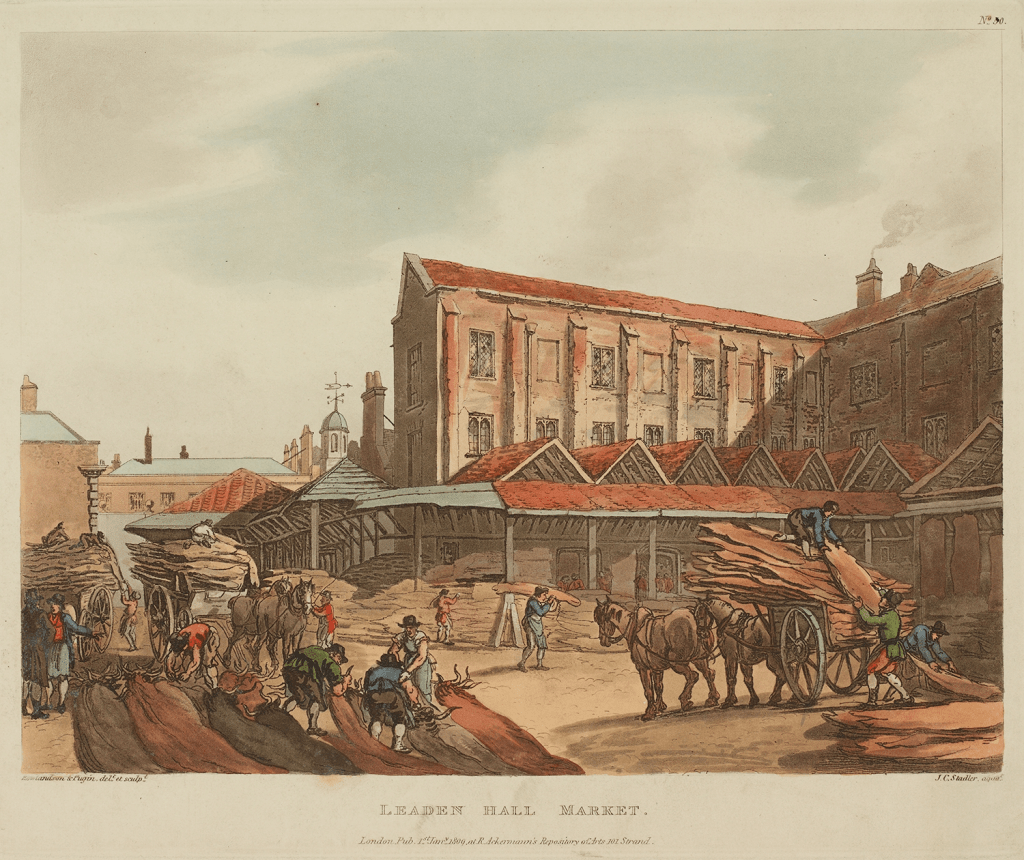
The forerunner of today’s market seems to have been from the instigation of the man who did more than anyone to shape the City, Richard Whittington. In 1408 Dick acquired the leasehold of the building and it quickly became one of the best places in London to buy meat, game, poultry and fish. Three years later, Whittington acquired the market site itself, which he then gifted to the City of London Corporation, who have been running it ever since.
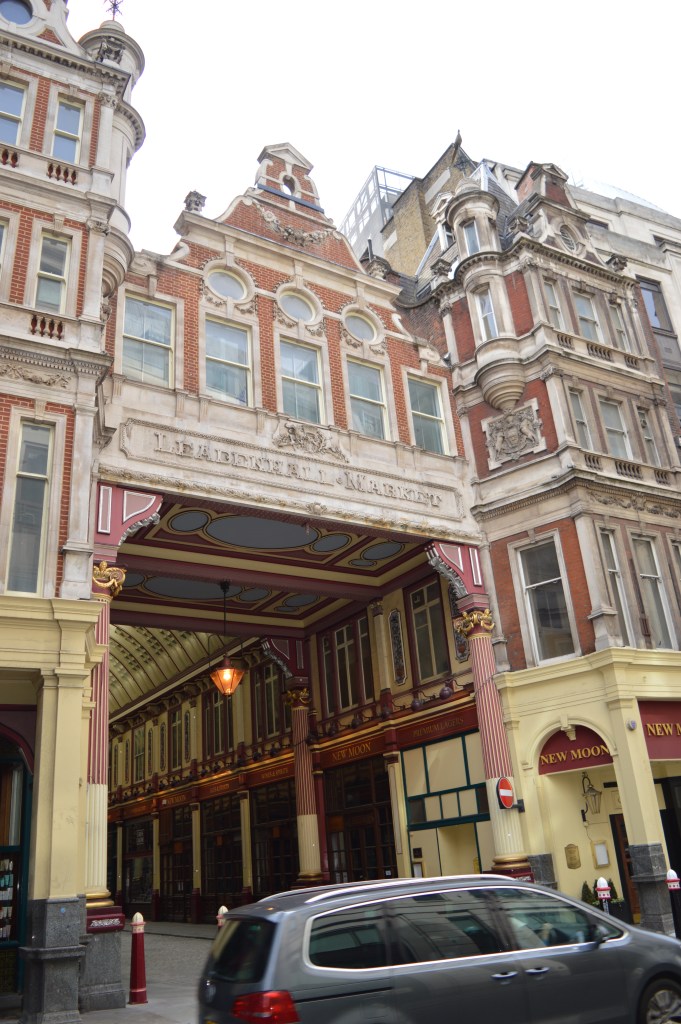
In 1666 parts of the Market were damaged by the Great Fire and were subsequently rebuilt.
The existing wrought iron and glass roof buildings were designed by the City Architect Horace Jones and built by the Corporation in 1881. There are few if any pictorial records of how the pre Jones market looked but it’s probably was similar to the picture posted at the beginning of this piece, and it in this incarnation that the story I mentioned at the outset played out.

During the early 1800s the market was the go to location for meat cheese and fish, but above all it seemed to be the City’s main market for the sale of geese. The story starts about 250km from London in the port of Ostend. A Drover had brought a large flock of geese to the port awaiting transportation to London. It was common practice to move the flock of female birds by walking them to their destination and this could take several days. In order to keep the flock in line the Gander associated with the flock was brought along with them. Once the destination had been reached the Gander was separated from the flock and returned to the farm to start the breading process off again.
During the run up to Christmas 1797 the requirements for geese in London was reaching it’s height and consignments of live animals were crossing the channel daily to keep up with the demand. Enter the hero of the story, Old Tom, however back in December 1797 he was neither old or known as Tom. He was a Gander of fine proportions and very desirable for breeding purposes, he was also a very amorous gentleman. It appears that within his flock he had a particular favourite and when he was separated from his sweetheart he became very agitated and in common parlance, Kicked off! It appears that he escaped the Drover and somehow found his way onto the ship holding his beloved and travelled with her all the way to Leadenhall Market.

It is recorded that over two consecutive days in the run up to Christmas 34,000 geese were slaughtered in the Market, one of these being Tom’s lady friend. However, Tom escaped the Butcher’s cleaver and was left to wander around the area of the market unharmed. He soon became a great favourite in the Market and was a regular customer at the local inns where he was fed scraps that were specially saved just for him.

Tom went on to live until the ripe old age of 37 when he died of natural causes and was buried on the market site. So beloved was Old Tom that he even made it into the Times Newspaper! Below is his obituary, published on 16 April 1835:
In memory of Old Tom the Gander.
Obit 19th March, 1835, aetat, 37 years, 9 months, and 6 days.
‘This famous gander, while in stubble,
Fed freely, without care or trouble:
Grew fat with corn and sitting still, And scarce could cross the barn-door sill:
And seldom waddled forth to cool
His belly in the neighbouring pool.
Transplanted to another scene,
He stalk’d in state o’er Calais-green,
With full five hundred geese behind,
To his superior care consign’d,
Whom readily he would engage
To lead in march ten miles a-stage.
Thus a decoy he lived and died,
The chief of geese, the poulterer’s pride.’
Well that just about wraps it up for another year, I’m going to take a short break over the festive period so can I wish you a very merry Christmas and a happy New Year. If you’re a regular reader of my posts, then thank you for sticking with it and a big thank you to all those who have taken the time and trouble to post comments and give me some feedback, much appreciated.
.

 A LONDON MISCELLANY
3 years old? That sounds Guinness Book of Records stuff. He obviously didn’t die of a broken heart. I love your posts – I always learn something new, so take that well-deserved break, and have a happy Christmas, and follow it up with a good 2025.
LikeLiked by 1 person
Thank you Margaret have a good one yourself
LikeLike