I’ve crossed this street so many times without even looking at what it was called. Running north from the Euston Road it was just another obstacle to be forded in the mad dash to catch a train from either Euston or St Pancras Stations. From the Euston Road end you look and see the British Library and not much more, but as I found, the street has a long history.
It wasn’t until I happened to spend a more leisurely day in the area that I clocked it’s name for the first time. The street sits snuggly beside the British Library but predates the repository by a good one hundred and seventy years. Before that it nestled alongside the Midland Railway’s Goods Yard and Potato Market.
What piqued my interest in it is the name itself. It’s a rather strange word “Ossulston” and I have to admit I’m not too sure how to pronounce it correctly. My initial guess was someones name, but a search provided little in the way of clarification, so I decided to start at the beginning of the street’s life to see if it offered clues.
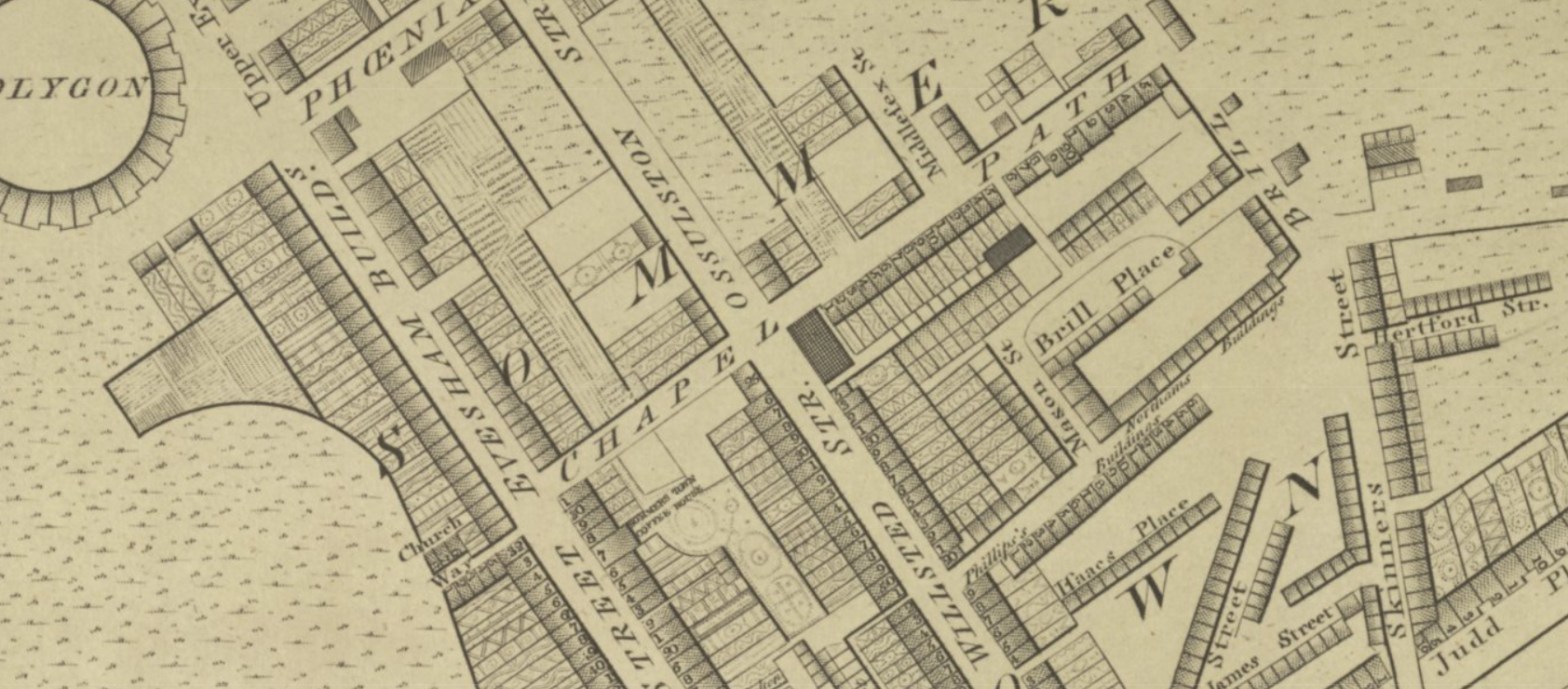
Maps of the late 1750s show the area, known as Somers Town, as open heath, but by the 1800s the area was partially developed and Ossulston Street makes it’s first appearance, however only as the northern half of the street.
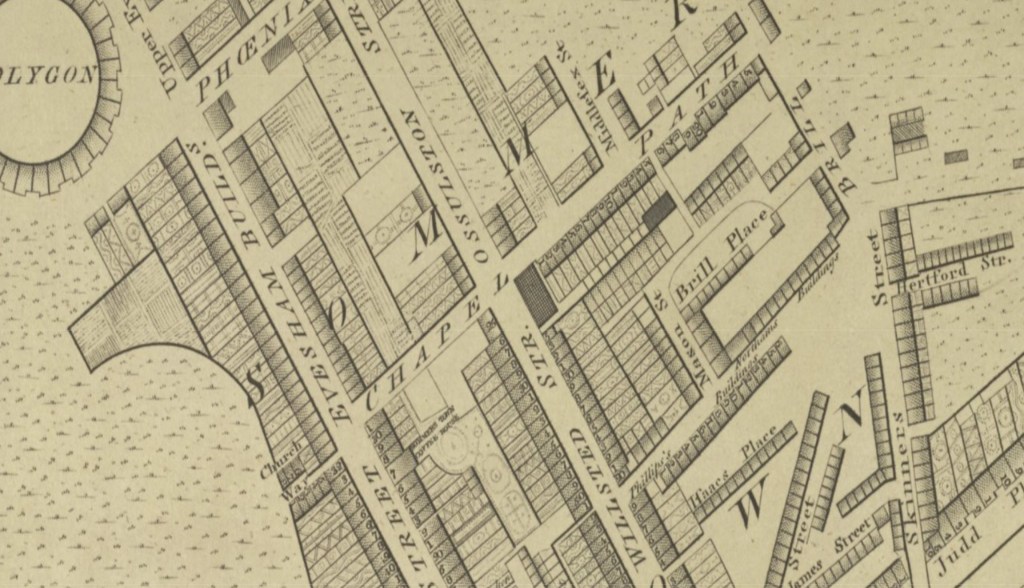
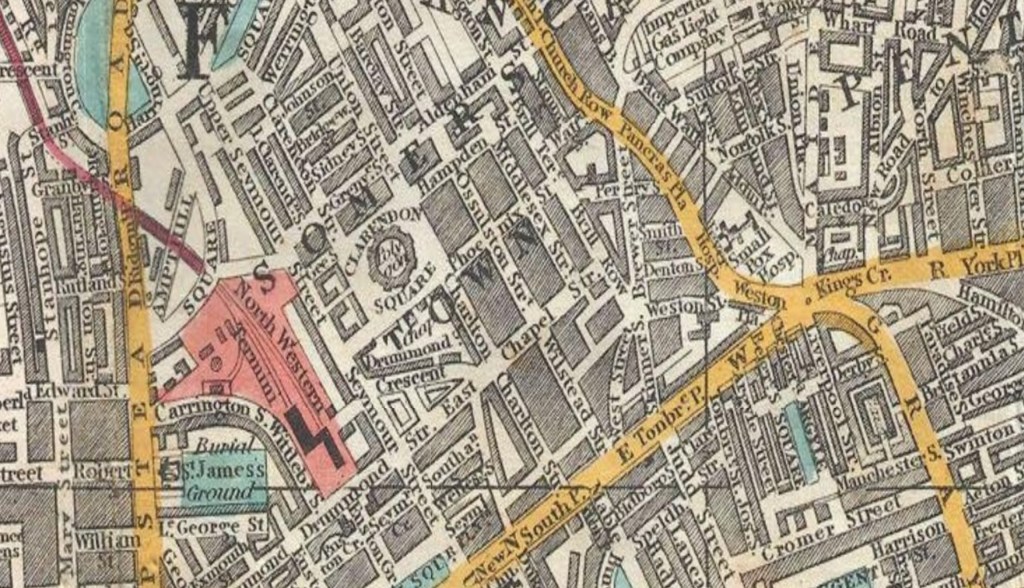
The settlement of Somers Town was greatly hastened through it becoming the home of refugees from the French Revolution, who sought cheap accommodation. The map of 1850 shows the tremendous increase in development over the intervening period.
Obviously moving forward in time wasn’t going to give me any clues as to the derivation of the name, so I turned back to the earliest maps of when the area was still heathland. These showed that the area resided in the county of Middlesex. Counties were dived up into areas known as Hundreds, which were administrative regions of the larger county. On searching a list of Middlesex Hundreds, I found the derivation of the name.
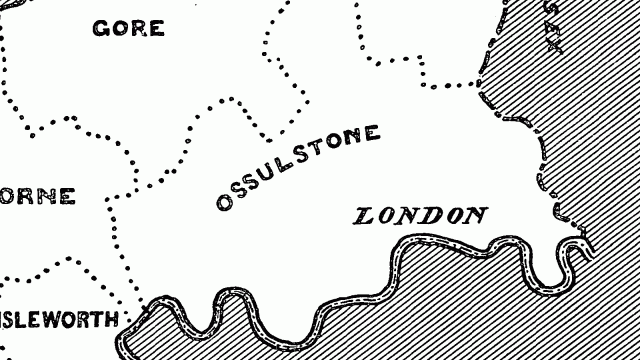
Ossulston was at one time a Hundred of the county and the derivation of it’s name is said to come from “Oswald’s Stone” or “Oswulf’s Stone”, an unmarked minor pre-Roman monolith which stood at Tyburn (the modern-day junction of the Edgware Road with Bayswater Road). Oswald’s Stone was earthed over in 1819, but dug up three years later because of its presumed historical significance. Later in the 19th century it was to be found leaning against Marble Arch. In 1869, shortly after an archaeological journal published an article about the stone, it disappeared and it has not been found since. So that cleared up the issue of the name, which I’m now pronouncing phonetically, “Ozzlestone“. In the next post I’ll take a look at the street in more detail.

 A LONDON MISCELLANY
I had barely read the first paragraph when the street name piqued my curiosity.
Thanks for saving me the time and trouble! 😉
LikeLike